

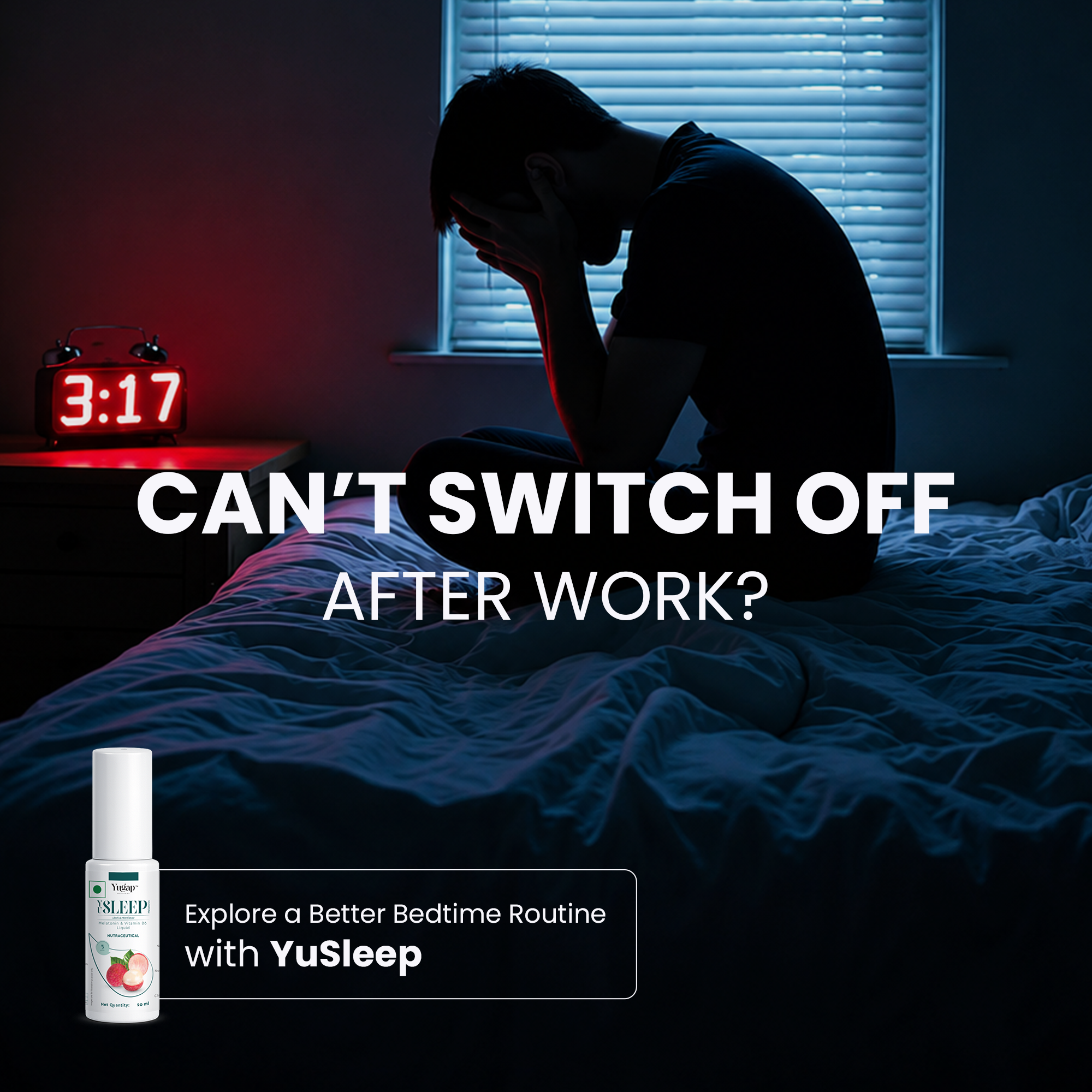
You’ll learn about better bedtime routines that you can follow, stress relief strategies that you can incorporate into your life and how supplements like YuSleep may help you with sleeping.
Introduction
If you’re someone who identifies as a night owl, you’re not alone. Many people struggle with the same issue. You close your laptop; your workday is over and somehow you’re still unable to sleep. This all happens because your mind is still not at rest.
Even when you’re lying on the bed, you're still replaying meetings, thinking about unfinished tasks, and mentally writing tomorrow's emails. If you've ever found yourself saying, "I can't sleep thinking about work," you're far from alone.
How to switch off after work and sleep has become a common debate since remote work has taken over. Remote work extends office hours and thus results in stress following you home.
However, the good news is that you can fix this. You can sleep peacefully. A structured bedtime routine for working professionals, combined with healthy sleep habits and supportive products such as YuSleep Oral Sleep Spray, may help you have restful nights.
In this blog, we’ll talk about why work stress interferes with sleep, practical ways to disconnect from work mentally, and how a better evening routine can help you fall asleep faster and wake up refreshed. Starting with why the work you do keeps your brain awake at night.
Why work stress keeps your brain awake at night
There is a thing called a “stress system response” which activates when you’re dealing with deadlines, performance pressure and client demands. This response is one of the major reasons you’re unable to sleep, as it releases cortisol and adrenaline hormones that increase your alertness and prepare you for action.
This response is fine till work hours but after evening it can impact both your sleep quality and sleep duration (Suni, 2025).
Working late can often result in the following:
-
Difficulty falling asleep
-
Frequent nighttime awakenings
-
Sleep that is unrefreshing
-
Waking early in the morning
-
Mental fatigue during the day
Don’t confuse a stress management problem with a sleep problem. Both are different and what you’re suffering from is a stress management problem. It’s also not entirely your fault. Your brain replays the work at night, which makes it hard for you to sleep, let’s understand why.
Why your brain replays work at night
Have you ever noticed how work seems a little easier at night? There’s a reason behind it: during the day, your brain is occupied with distractions, whereas at night the quietness creates a space where your unresolved concerns start to rise.
Some people call it the “unfinished task effect". It’s when you remember uncompleted tasks better than completed ones (Wikipedia contributors, 2026). Your brain wants closure and when projects remain incomplete, your mind doesn't rest; it keeps on revisiting them.
For example, think of it like you’ve opened 20 browser tabs on your laptop but you’re using one. Rest 19 are still working in the background, consuming energy even when you’re not explicitly using them.
This exact thing happens with your mind too. It doesn’t matter what you’re thinking at the moment. What matters is what you were all thinking throughout the day. The stress you take is quietly affecting your sleep and overall health. Let’s look at the signs that will help you understand if your work stress is affecting your sleep or not.
Signs that work stress is affecting your sleep
If you don’t believe that the reason behind you not sleeping properly is the work stress you have, these signs may help you relate.
Here are some common warning signs.
-
Racing thoughts at bedtime
-
Waking up unwillingly at 3-4 am
-
Feeling exhausted, still unable to sleep
-
Having the urge to check emails before sleep
-
Waking up everyday with morning exhaustion and irritation
-
Suffering from brain fog and irritability throughout your work day
If any or several of these signs are sounding familiar to you, it’s high time to work on your evening habits. Starting with how to switch off after work and sleep more easily.
How to switch off after work and sleep more easily
Create a "shutdown ritual"
The first thing you need is to create a shutdown ritual. This doesn’t mean that you need to abruptly end your work, no. It means instead of finishing off your work at 7:00PM and eating dinner at 7:01PM, you should focus on creating a routine that helps your brain shut down properly.
For example:
-
Review completed tasks.
-
Write tomorrow's priorities.
-
Close all work applications.
-
Turn off work notifications.
-
Physically leave your workspace.
This is a simple process but a very effective one, as it’ll send a powerful message to your brain saying, “work is finished for today” (Study Hacks & Study Hacks, 2023). What you can also do is use the brain dump technique.
What is the "brain dump" technique?
Try writing down every concern that you have about work, life or anything before bed. Get a notebook and answer just these 3 questions.
-
What am I worried about?
-
What needs my attention tomorrow?
-
What action will I take?
This rather simple exercise will help in reducing the stress you often suffer from at night. Let’s now create a bedtime routine for you.
A bedtime routine for working professionals
The ideal 60-minute evening routine
Morning routines are important, no doubts about that. But so are nighttime routines. If your night is not good, you won’t be good. Here's a simple 60 minute evening routine that you can follow:
-
Stop checking emails before 60 minutes to go to bed
-
Take a shower or do light stretching before 45 minutes to bed
-
Read or journal before 30 minutes to bed
-
Meditate a little or do breathing exercises for 15 minutes to bed
-
Voila, Good night!
Do this consistently and you shall have a routine that helps you sleep peacefully. You can also include supplements such as YuSleep in your routine to sleep peacefully.
Reduce screen time
If you’re someone who uses their phone/laptop a lot during the night, it’s time you stop it. Excessive screen time is already unhealthy for you, and using it before bed may interfere with your sleep.
We’d suggest stopping using a screen 60 minutes before bed; however, if you’re still keen on using it, try these:
-
Turn on the night mode of your device
-
Limit the social media you use
-
Avoid any work-related content
-
Keep your phones away from your pillow
These small changes might result in you having a peaceful sleep. Try them.
Create a sleep-friendly environment
You don’t need the office environment in your bedroom. The white lights, monotonous color scheme, etc. What you need is;
-
Cooler room temperatures
-
Blackout curtains
-
Minimal noise
-
Comfortable bedding
Your bedroom is your bridge to rest. Making it productive will only result in obstacles; the more your bedroom environment is soothing, the better your sleep will be.
Sleep researchers often describe the bedroom as a cue for rest. The more your environment supports sleep, the easier it becomes to fall asleep. Let’s now talk about what to do if even after doing all these things, you still aren’t able to sleep.
How to sleep faster when work thoughts won't stop
Practice controlled breathing
Breathing is everything; if you can breathe properly, you can live properly. And slow breathing is one of the quickest ways to calm the nervous system.
Try this:
-
Inhale for 4 seconds
-
Hold for 2 seconds
-
Exhale for 6 seconds
Repeat for five minutes; the longer the exhalations are, the more your body will relax and counter stress.
Avoid common sleep mistakes
Avoid:
-
Avoid having coffee in the evening
-
Avoid exercising before bed
-
Avoid watching stressful content at night
Removing such obstacles won’t affect your sleep instantly; they’ll improve your sleep gradually. But if you’re looking for instant assistance with your sleep, you should try YuGap’s fast-acting sleep spray for adults, YuSleep. Let’s see how you can add this spray to your bedtime routine.
Where a fast-sleeping spray may fit into your bedtime routine
If you don’t know what sleeping spray is, it's nothing but melatonin. It’s the same as the hormone that is naturally produced by the body during the evening.
Melatonin helps you regulate your sleep-wake cycle, and some choose a melatonin oral spray because it's convenient and easy to use as part of their bedtime routine.
Supplements such as YuSleep are better than traditional tablets, as they can be used quickly without water. If you’re thinking, what exactly is YuSleep?', let us tell you.
What is YuSleep Oral Sleep Spray?
YuSleep is an oral sleep spray formulated with melatonin and Vitamin B6 designed to help you fall asleep faster and regulate your natural sleep-wake cycle. It is a convenient, non-habit-forming alternative to traditional sleep pills that absorbs quickly through the mouth, aiming to prevent next-day grogginess (YuSleep – Oral Spray | 20ml, n.d.).
When you combine YuSleep with:
-
Consistent sleep schedules
-
Reduced evening stress
-
Healthy sleep hygiene
-
Proper bedtime routines
It may help you with sleeping peacefully. However, it's important to remember that even the best fast-acting sleep spray for adults works most effectively when paired with strong sleep habits.
Conclusion
Sleeping is more important than you think. Having a good night’s sleep results in better functioning of your body, refreshed mind and a positive day. Start creating boundaries, when work follows you to bed, you won’t sleep. Leave your work at the office and create an environment where sleep comes naturally; if not, use YuSleep.
We discussed how you can switch off after work and sleep, the bedtime routine you can follow to reduce mental clutter and many more things. Visit this blog again if you suffer; hopefully you won't.
FAQs
Why can't I sleep thinking about work?
Work stress can increase mental alertness and trigger repetitive thought patterns that make relaxation difficult.
How can I switch off after work and sleep?
Create a clear work shutdown routine, avoid work-related activities before bed, and practice relaxation techniques.
What is the best bedtime routine for working professionals?
A consistent routine that includes reduced screen time, relaxation activities, reading, and stress management strategies is often most effective.
How do I sleep faster when stressed?
Breathing exercises, journaling, mindfulness practices, and improving sleep hygiene can help calm the nervous system before bed.
What is a melatonin oral spray?
A melatonin oral spray delivers melatonin through an easy-to-use spray format designed to support the body's natural sleep cycle.
Is YuSleep Oral Sleep Spray a replacement for good sleep habits?
No. YuSleep Oral Sleep Spray works best when used alongside healthy sleep practices and a consistent bedtime routine.
References
-
Study Hacks & Study Hacks. (2023, January 26). Drastically Reduce Stress with a Work Shutdown Ritual. Cal Newport. https://calnewport.com/drastically-reduce-stress-with-a-work-shutdown-ritual/
-
Suni, E. (2025, July 7). Mastering Sleep Hygiene: Your path to quality sleep. Sleep Foundation. https://www.sleepfoundation.org/sleep-hygiene
-
Wikipedia contributors. (2026, May 22). Zeigarnik effect. Wikipedia. https://en.wikipedia.org/wiki/Zeigarnik_effect
-
YuSleep – Oral Spray | 20ml. (n.d.). YuGap Wellness. https://yugap.com/products/yusleep?srsltid=AfmBOoqH4F3pEPnc5rnNtRSY7oy8u-0OuuVAO3uiObHrPzkg7iBEtyvz
Share:
International Day of Yoga 2026: Move, Breathe and Feel Your Best
National Doctors' Day 2026: Expert Tips for Better Health and Preventive Wellness