

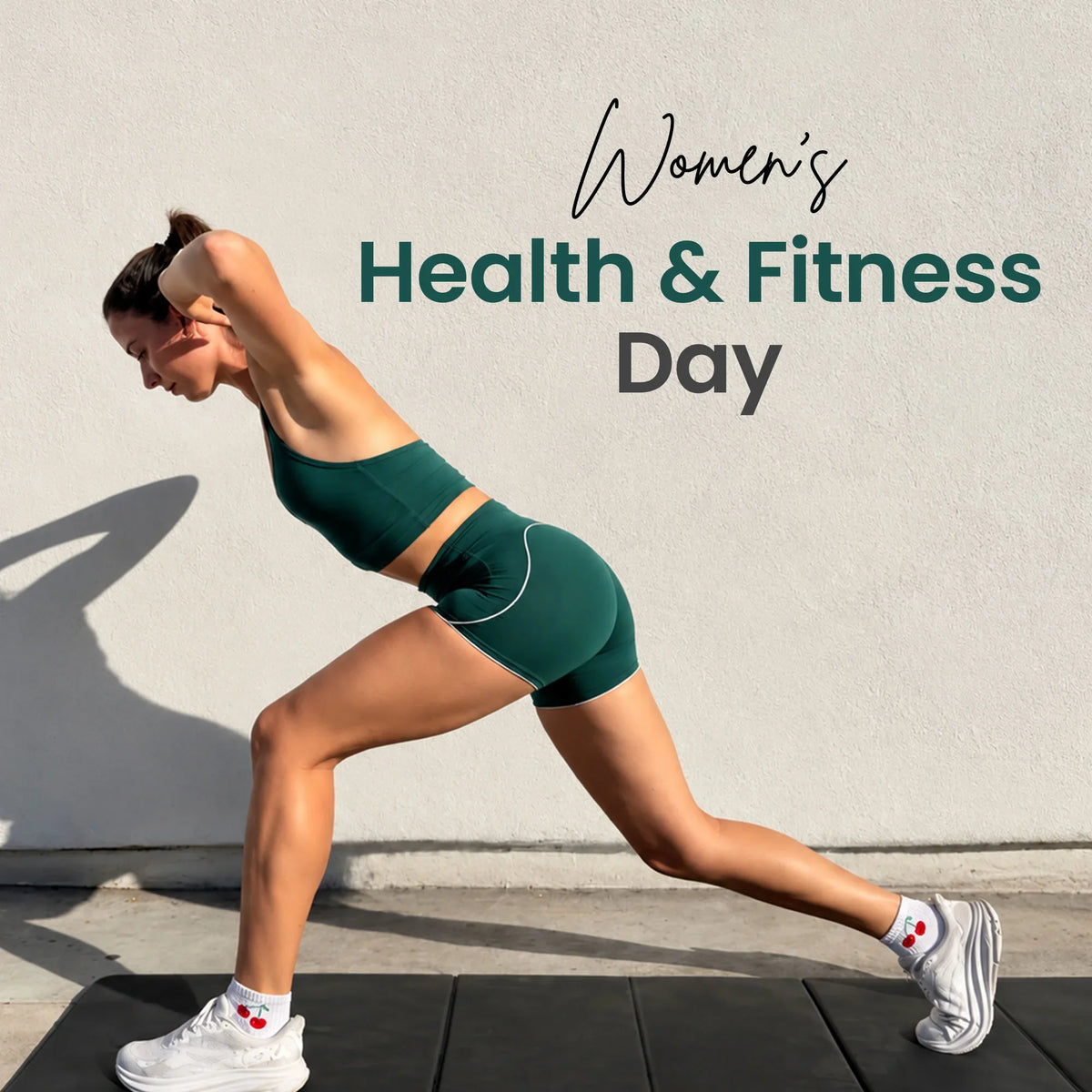
Learn, besides weight loss, how exercise can improve women's fitness and health – build their muscles, bones, and heart health; boost their confidence, mobility, and healthy ageing.
Introduction
For so many years women's fitness has been shown in one dimension – losing weight and shrinking.
However, this isn't the full extent to which exercise can really help.
Through exercise, one can maintain an independent lifestyle while getting a stronger heart, maintaining muscle, supporting and strengthening bone health, balancing health, boosting mood, improving metabolic health and remaining independent. All these benefits are important regardless of whether the losses on the weighing scale are present.
It's for this purpose that National Women's Health & Fitness Day 2026 on Wednesday, the 30th of September, is a good time to reevaluate your definition of fitness. The annual event occurs on the final Wednesday of September in a year and encourages women of all ages to stay fit and raise health awareness.
Don't set a smaller body as an objective of your fitness.
It can be a more powerful, wholesome, stronger body.
Benefits of exercise for women beyond weight loss
Exercising regularly can help maintain cardiovascular health, improve muscle and bone fitness, improve metabolic health, help mental health, increase mobility, and help prevent healthy ageing. The current guidelines for physical activity for adults are a minimum of 150 minutes of moderate-intensity aerobic activity per week, plus muscle strengthening on at least 2 days Physical Activity, n.d.).
This exercise can improve the athlete's agility and quickness.
-
Cardiovascular fitness
-
Muscle strength
-
Bone health
-
Balance and coordination
-
Blood-sugar regulation
-
Sleep quality
-
Mood and mental wellbeing.
-
Physical independence
-
All daily energy- and stamina-enhancing activities.
Why should women exercise if not for weight loss?
Your body will require strength, not a smaller size.
Suppose that the two females have exactly the same weight. Carrying groceries, going up and down multiple flights of stairs, lifting a suitcase into an overhead or getting up from a floor are all easy to do. The other is at a disadvantage at dealing with those things.
They say that they are the same scale! They are not physically able.
The reasons why fitness will have to be measured more and more by what your body can do, rather than what it weighs.
Women with a history of strength training can enjoy improved muscle strength, bone density, joint stability, balance, mobility and posture, better blood-sugar control, a better mood and a boost in confidence (Harvard Health, 2026).
What are the benefits of exercise for women besides weight loss?
1. Stronger muscles
Muscle makes working the muscles around your body easier.
Muscular strength is essential for carrying groceries, picking children up, going up and down stairs, travelling, gardening and just not standing well, to list just a few.
Muscle is also more relevant to older age, as naturally muscle mass and strength will decrease with age.
Exercises that help to slow down this process are called strength training.
2. Stronger bones
It's so important for women to consider bone health well in advance of the time that it begins to worry them.
Resistance training/weight-bearing exercise puts mechanical stress on bones, which causes the body to retain or build bone strength. It is especially relevant when women reach middle age and menopausal age, and the level of oestrogen begins to drop, which can lead to increased bone loss.
Weight-bearing exercise and strength training may be beneficial to counteract the risk of bone loss due to getting older and promote stronger bones (Salamon, 2026).
3. Better cardiovascular health
Cardio is more than a calorie burn.
Aerobic exercise, such as walking, cycling, swimming, running, dancing and more, poses a challenge to the cardiovascular system and can contribute to the health of the heart, blood pressure, and endurance.
Cardiovascular disease risk factors may change as women advance in age and into midlife and older, making aerobic exercise especially beneficial.
4. Better mental wellbeing
When you exercise, it has a body impact, as well as a brain effect. Exercise helps to maintain your emotional health, mitigate stress, improve sleep and promote mental health.
One of the reasons not getting exhausted after the exercise doesn't bother me means it is valuable. A 30-minute walk can be just what the doctor ordered.
Why is muscle important for women?
The outward look of a man needn't reflect the inner tone of his muscles.
This is the tissue on which you carry out your activities, control or stabilise your joints and make your body function properly and maintain its balance while standing, working, or resting. Good muscles also enable you to ward off physical deterioration.
One important way to become and remain independent during the ageing process is to have strength. When muscles are stronger, mobility is improved and the potential damage done by falls and lack of mobility is minimised.
Consider muscle to be one of your body's "reserves".
Do not build muscle for now's workouts. You're developing physical fitness for the years to come. This is especially important as independence is even more valuable as you get older.
Does lifting weights make women bulky?
This is among the most tenacious fitness misconceptions out there about women.
Weight lifting doesn't make most women look like the Hulk. Weight lifting isn't a quick method to make most girls start looking like the hulk.
To get big muscles, you need to work the muscles with resistance exercises, good food, steady progress and TIME. Women are also physiologically different from men and have significant lower average testosterone levels.
On the contrary, resistance training can assist in developing the physically powerful body that lots of women desire.
How much exercise do women need after 30?
The milestone of 30 doesn't mean that you should drastically change your workout.
It can be a great time to make an extra effort to build up muscle, build up bone, improve heart and lung strength, improve mobility and improve recovery.
The fundamental goal is:
Weekly exercise goal
-
150 minutes of moderate-intensity aerobic activity
-
2 or more days of muscle-strengthening activity
-
Additional activity for greater health benefits when appropriate
-
Regular movement throughout the day
You can divide those minutes however works for your schedule. You don't need to complete all 150 minutes in long gym sessions.
A simple example
|
Day |
Activity |
|
Monday |
Strength training |
|
Tuesday |
30-minute brisk walk |
|
Wednesday |
Strength training |
|
Thursday |
Cycling or walking |
|
Friday |
Rest or light movement |
|
Saturday |
Strength + short cardio |
|
Sunday |
Easy walk / recovery |
Consistency beats an unrealistic six-day plan you'll abandon after two weeks.
Is cardio enough for women's fitness?
Cardio is excellent, but cardio alone isn't the whole picture.
Running, walking, cycling, swimming, and other aerobic activities support cardiovascular fitness. But they don't provide the same muscle and bone stimulus as resistance training.
That's why a balanced routine should include both.
For women concerned about healthy ageing, strength training becomes particularly valuable because muscle and bone loss can become more significant over time.
Fitness after 30, 40, 50 and beyond: What should change?
The basic principles remain remarkably consistent.
What changes is the priority.
In your 20s–30s
Focus on:
-
Building strength
-
Developing cardiovascular fitness
-
Establishing consistent habits
-
Learning proper technique
In your 40s
Prioritise:
-
Maintaining muscle
-
Strength training
-
Cardiovascular health
-
Mobility
-
Recovery
In your 50s+
Emphasise:
-
Strength
-
Bone health
-
Balance
-
Mobility
-
Cardiovascular fitness
-
Independence
The goal isn't to exercise like you're 25 forever.
It's to remain capable at every age.
A better way to measure women's fitness
If weight is your only metric, you miss most of the story.
Instead, track:
|
Fitness Marker |
Question to Ask |
|
Strength |
Can I lift more safely than six months ago? |
|
Endurance |
Can I walk or exercise longer without getting exhausted? |
|
Mobility |
Can I move comfortably through everyday activities? |
|
Balance |
Do I feel stable on my feet? |
|
Recovery |
Am I recovering well between sessions? |
|
Energy |
Do I feel more capable during the day? |
|
Consistency |
Can I maintain my routine? |
Your body is more than a number on a weighing scale.
A simple women's fitness routine beyond weight loss
You don't need an elaborate programme.
Start with three pillars.
1. Strength
Train major muscle groups at least twice a week.
Examples:
-
Squats
-
Lunges
-
Rows
-
Push-ups
-
Hip hinges
-
Shoulder presses
2. Cardio
Choose something you genuinely enjoy.
-
Brisk walking
-
Cycling
-
Swimming
-
Dancing
-
Jogging
-
Sports
3. Recovery
Don't treat recovery as laziness.
Prioritise:
-
Sleep
-
Rest days
-
Adequate nutrition
-
Hydration
-
Mobility work
A sustainable fitness routine should make your life better, not consume it.
Conclusion
Being fit should mean developing a fit body and a healthy mind. Losing or gaining weight is one reason to exercise, but it is not the only one.
Move to improve your mood, sleep quality, heart health, balance, and confidence. Join us on National Women's Health & Fitness Day 2026 in dispelling the myth that fitness is solely a female issue centred on the scale!
Do not set a goal of "smaller". Strive to become stronger, healthier, more capable, and independent.
FAQs
So why should women exercise if not for their well-being and weight loss?
Exercise benefits the heart, musculoskeletal development, bone health, movement, balance, well-being, sleep, metabolic health and social function.
What other advantages are there to exercising other than losing weight?
Improved muscle and bone strength, better heart function, improved mood and sleep, improved balance and improved functional ability.
Which is the best for women: strength training or cardio?
There's no right or wrong answer. Cardio helps to keep your heart and lungs healthy and functioning, and strength training can help you keep your muscles and bones slow and strong, especially. A mixture is the best choice.
Why is muscle important for women?
Muscle activity helps in maintaining physical independence, maintaining posture, supporting movement, maintaining balance, strengthening and maintaining metabolism. As age increases, maintaining muscle becomes more and more important.
Will weight training make women bulky?
Not automatically. The majority of women who lift weights become strong and toned without going through the experience of gaining "bulkiness. Most of the women who do some strength training will gain muscle definition and strength but not go from very bulky to plain and ordinary.
What is the amount of physical activity women should get after 30?
Most healthy adults should be getting at least 150 minutes per week of moderate aerobic exercise and muscle-strengthening exercises at least 2 days each week.
Does the loss of lost calories constitute fitness for a girl?
Like I said, although cardio is essential, it can't be the only form of training. A well-balanced activity should contain aerobic and muscle-strengthening exercises.
References
-
Harvard Health. (2026, January 12). Strength training builds more than muscles. https://www.health.harvard.edu/staying-healthy/strength-training-builds-more-than-muscles?utm_source=
-
Physical activity. (n.d.). https://www.who.int/initiatives/behealthy/physical-activity
-
Salamon, M. (2026, January 22). Strong is the new skinny. Harvard Health. https://www.health.harvard.edu/womens-health/strong-is-the-new-skinny?utm_source=
Share:
World Heart Day 2026: Silent Heart Symptoms Indians Mistake for Acidity