

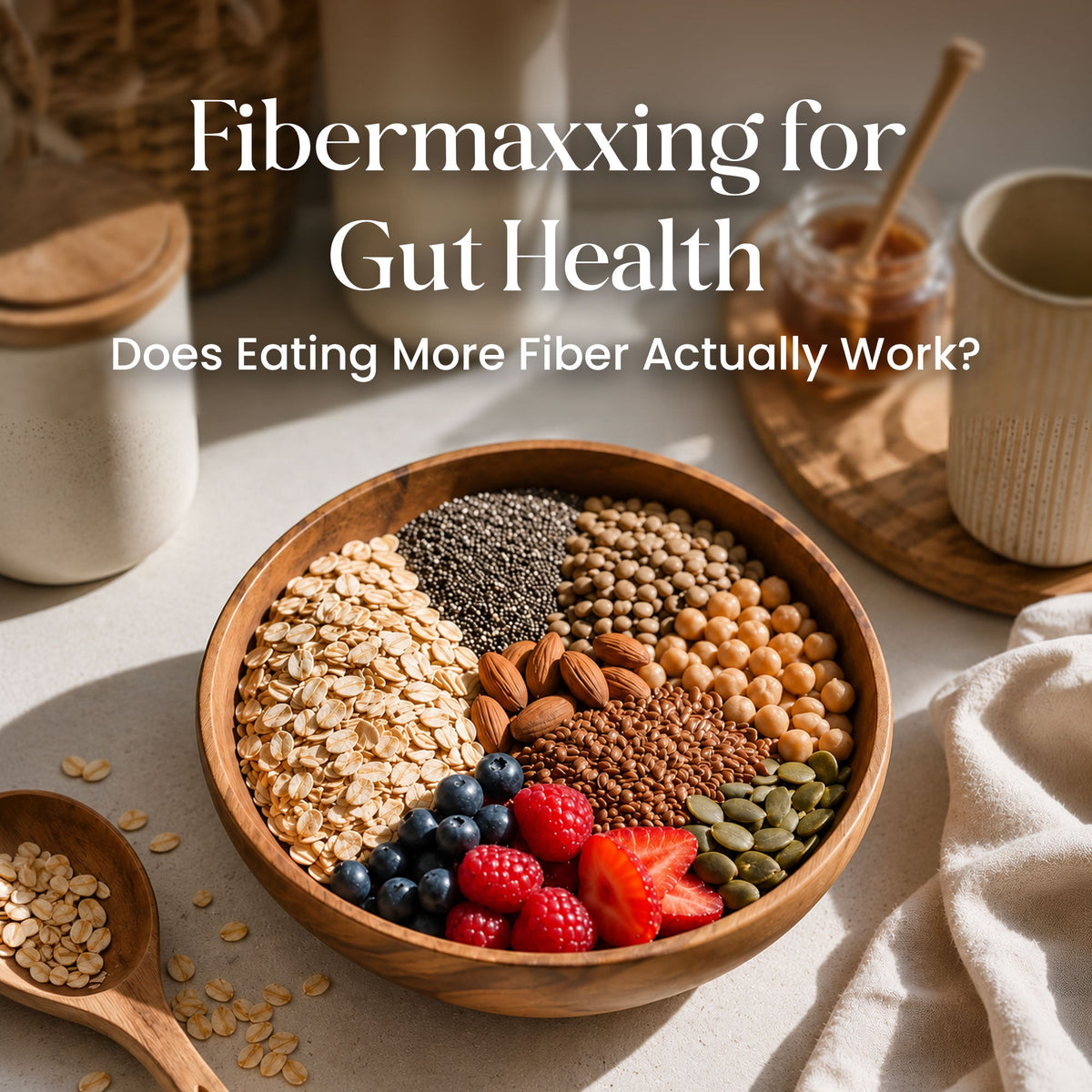
What's fibre maximising, and how much fibre are you supposed to eat daily, and would it really help you have a healthy gut? Understand the need for a high fibre diet, constipation and supplements.
What is fibremaxxing?
Fibremaxxing is the practice of intentionally increasing dietary fibre intake, usually to reach a high daily target.
The concept seems easy to grasp:
The more fibre, the better the digestion → better gut health.
There is indeed a trend here:
Fibre consists of a complex variety of carbohydrates which are not fully broken down in the small intestine. Depending on the type, it may bulk the stool, hold water, slow down the digestion process, affect blood glucose absorption and affect the digestion process with the ability to supply nutrition for gut microorganisms.
However, fibremaxxing doesn't mean having to force a tonne of fibre on yourself.
There is a limit to how much your digestive system can do. You might find that sudden changes from a low-fibre diet to a very high fibre diet can cause gas, bloating and/or discomfort if you experience the trouble. However, if you switch suddenly from a low-fibre diet to a very high-fibre diet, you may end up with gas, bloating and/or discomfort in your abdomen or even make constipation worse.
When switching, pay particular attention to gradually up your fibre intake and make sure you drink enough liquids (Clinic, 2022).
So a better definition is:
fibremaxxing isn't about maximising fibre. It's about optimising your fibre intake.
Does fibre Improve gut health?
Yes, but it isn't just fibre; fibre type, quantity and origin are important as well.
Your gut doesn't digest all fibre at the same rate. Some fibres are fermented by microorganisms in the colon, and others mainly swell up when they come into contact with bacteria in the gut or bulk up faeces or promote bowel movement through the digestive system.
That's why it's better to eat a diverse diet that contains some fibre rather than another fibre powder.
Fermentable fibres are able to be metabolised by the gut microbe flora, which create metabolites like short-chain fatty acids (SCFAs). Other fibres bulk the stool up or are able to retain water, which promotes regular stools.
Certain fibre is a meal for great microopus, as some diets higher in fibre can help the health of the colon and combat constipation.
Think of fibre as a toolbox.
|
Type/function |
What it can do |
|
Soluble fibre |
Makes a gel-like substance and may affect digestion and uptake of glucose. |
|
Insoluble fibre |
Aids in stool passage along the colon and facilitates bulk absorption. |
|
Fermentable fibre |
Can be used by the gut microbes |
|
Prebiotic fibre |
Fights off the bad guys while letting the good guys be unharmed |
These categories can overlap. A fibre can be soluble, fermentable and prebiotic depending on its specific structure.
How much fibre per day do you actually need?
This is where fibremaxxing can go wrong.
You don't need 50, 70 or 100 grams of fibre simply because someone online says that more is better.
General recommendations are commonly around 14 grams per 1,000 calories, although individual needs vary. Current U.S. dietary guidance translates that into approximately 25–34 grams per day for many adults, depending on age and sex (Clinic, 2025).
A practical fibre target
|
Daily intake |
What it generally means |
|
<15 g |
Often quite low |
|
15–24 g |
May still be below many recommendations. |
|
25–35 g |
A practical target for many adults |
|
35–40+ g |
Can be appropriate for some people |
|
Very high intake |
Not automatically healthier; tolerance matters. |
If you're currently eating only 12–15 grams a day, don't suddenly aim for 40 grams tomorrow.
Build up gradually.
What happens when you eat more fibre?
Your body doesn't simply “flush out toxins” when you increase fibre.
Instead, several physiological changes can occur.
1. Your stool may become bulkier.
Certain fibres increase stool mass, making bowel movements easier to pass.
2. Your bowel movements may become more regular.
Adequate fibre and fluid can support normal intestinal movement.
3. Your gut microbes get more fermentable material
Certain fibres become substrates for microbial fermentation.
4. You may feel fuller.
Fibre-rich foods often take longer to eat and digest, which can contribute to satiety.
5. You may experience temporary gas.
This is the part many “fibremaxxing” videos leave out.
More fermentable material can mean more microbial fermentation and gas, especially when the increase happens suddenly.
High-fibre diet for constipation: Does it actually work?
For many people, yes.
Constipation can involve infrequent bowel movements, hard or dry stools, difficulty passing stool or a feeling that you haven't completely emptied your bowel.
Fibre can help because it can increase stool bulk and, depending on the type, retain water or support easier passage.
But there's a critical condition:
Fibre needs adequate fluid.
Imagine adding dry material to a system without enough water. Increasing fibre while remaining chronically dehydrated may leave some people feeling more uncomfortable rather than less.
Fibre-rich foods for constipation
Try building meals around:
-
Oats
-
Barley
-
Dal
-
Lentils
-
Chickpeas
-
Rajma
-
Fruits
-
Vegetables
-
Chia seeds
-
Flax seeds
-
Nuts
-
Whole grains
Focus on consuming vegetables, fruits, legumes, whole grains, chia and other plant foods as fibre-rich choices that can support bowel regularity (Clinic, 2026).
What should your plate actually look like?
You don't need to eat enormous salads at every meal.
A better strategy is fibre distribution.
Breakfast
Oats + fruit + chia/flax seeds
Lunch
Dal + vegetables + roti or another whole-grain option
Snack
Fruit + nuts
Dinner
Vegetables + legumes/protein + an appropriate whole-grain carbohydrate
This approach gives your gut different types of fibre instead of relying on one concentrated source.
And variety matters.
A diet containing vegetables, fruits, legumes, whole grains, nuts and seeds provides a broader range of plant compounds and fibres than simply taking one fibre supplement every morning.
Fibremaxxing and the gut microbiome: More fibre, More bacteria?
More fibre doesn’t necessarily mean more bacteria.
The relationship is more complicated.
Your gut microbiome consists of thousands of microbial species that make up an ecosystem. Each type of microorganism has its own kind of substrate.
The fermentable fibres can favour certain groups of microorganisms whereas others have other effects.
When people talk about “feeding your good bacteria", some people use this as a simple explanation, but it's not the complete science.
The objective is not to achieve maximum growth of one particular bacterial species.
To help maintain a diversity and stability of the microbial ecosystem as part of a healthy diet.
Fibre supplements for constipation: Are they worth it?
Sometimes, however, food should generally be the foundation since its whole plant foods contain fibre in addition to vitamins, minerals and other compounds that are beneficial.
However, fibre supplements for constipation may help with the situation when only dietary fibre is not sufficient or recommended by such a professional.
Common supplemental fibres include:
-
Psyllium
-
Methylcellulose
-
Inulin
-
Certain soluble fibres
Daily fibre supplements appear safe for many people and can support bowel function, but they may initially cause gas and bloating. Start with smaller amounts and drinking adequate fluids.
Best fibre supplement India: What should you look for?
There isn't one universally best fibre supplement in India for everyone.
The right choice depends on your goal.
If constipation is the main concern, you might look for a well-tolerated bulk-forming fibre such as psyllium.
If you're specifically interested in microbiome support, a formulation containing fermentable or prebiotic fibres may be more relevant.
When comparing products, check:
-
Type of fibre
-
Fibre amount per serving
-
Added sugar
-
Artificial sweeteners or sugar alcohols
-
Serving instructions
-
Hydration requirements
-
Manufacturer information
-
Regulatory information
-
Potential medication interactions
And don't judge a product simply by the largest number on the label.
100% more fibre isn't necessarily 100% better.
Can you eat too much fibre?
Yes, but you should know that more fibre isn't automatically better.
Very high intakes can cause:
-
Gas
-
Bloating
-
Abdominal discomfort
-
Changes in bowel habits
-
Reduced appetite
-
If fibre-rich foods become too much, they may cause problems; you may need more protein to join heart failure groups or special meals.
Some even have to limit their intake of fibre in the short interim. A low-fibre diet may be recommended, for instance, in some cases of bowel obstruction, when a person has some inflammatory bowel disease, if they have diverticulitis, or if they are having a procedure done in the gastrointestinal (GI) tract.
Don't convey that a social-media fibre challenge is suitable for you if you have a gut condition.
Conclusion
Having sufficient fibre is a must, maximising fibre doesn't.
Fibre is beneficial when it comes to helping keep the bowels regular, digestive health, being satiated and the health of the gut microbiome. It can also play a role in health more broadly: metabolic health and the health of the cardiovascular system.
But extreme versions of fibremaxxing aren't the best.
It's a habit that continues to be sustainable:
More plants. More variety. Enough fibre. Enough water. Gradual increases.
But if your diet doesn't always give you sufficient fibre, then it may be necessary to take a suitable fibre supplement.
You don't require a super quantity of fibre.
It must have the proper quantities, and they must be delivered regularly.
FAQs
What is fibremaxxing?
Fibre maximising means intentionally eating foods that are high in fibre – typically from foods that are higher in their plant-based sources – and occasionally supplements, to enhance fibre levels. The quantity of fibre should be sufficient but not excessive.
What amount of fibre per day do I need?
The approximate recommended amounts for adults are 25–34 grams per day and vary based on individual requirements. There's the general rule of about 14 grams of sugar for every 1,000 calories.
Can fibre promote gut health?
Yes. Some fibres can also have an important effect on bowel function and acting as a substrate on the digestive microorganisms when fermentable. It is better that a variety of fibre sources are used rather than one source.
What are the consequences if you eat more fibre?
May have the digestion benefit of regular bowel movements and a feeling of fullness after eating. Faster introduction of fibre, though, can lead to gas, bloating and cramps.
So a high fibre diet is beneficial for constipation?
It can be. Fibre helps to make stools bulkier and can help to push them forward down the bowels as well as getting more exercise and fluid.
Is there any benefit of using fibre supplements to relieve constipation?
May help a specific group of people. Usually bulking agents such as psyllium are used, and bulk additives should be gradually added and sufficient fluids used.
Which fibre supplement is the best in India?
None of the products are the right one for everybody. Select depending on your digestive objective, size of the portion, elements, quality and tolerance.
References
-
Clinic, C. (2022, May 10). 8 home remedies for constipation. Cleveland Clinic. https://health.clevelandclinic.org/home-remedies-for-constipation
-
Clinic, C. (2025, April 30). Your fiber intake: What’s the right amount? Cleveland Clinic. https://health.clevelandclinic.org/how-much-fiber-per-day
-
Clinic, C. (2026, June 17). What foods are high in fiber? Cleveland Clinic. https://health.clevelandclinic.org/high-fiber-foods
Share:
The GLP-1 Problem: Why Ozempic Can Cause Muscle Loss & Gut Issues